
When the glory comes
You get what you give

What a day, friends. My soul is filled to the brim.
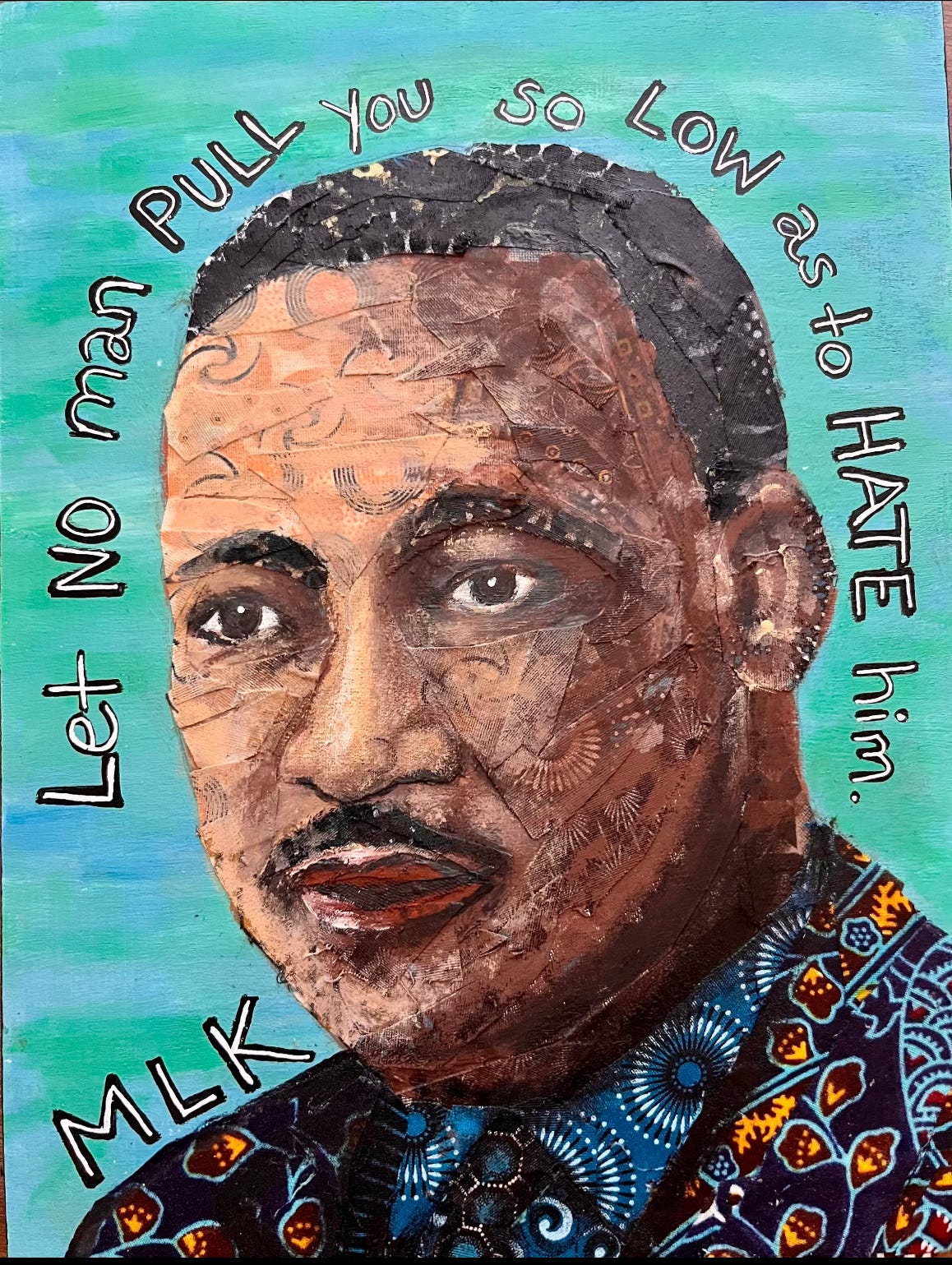
MLK Day has long been a day of service and reflection for the Black community in America, but I have always spent it mainly in sloth.

In recent years—especially since moving to our current church, where I have been exposed to much more of his and other Black pastors’ theological writings—I have done some minimal reading and reflection.
Today, I decided given everything (waves hands) that was enough of that. If MLK were still alive, he’d be 97, and you better believe he’d be out there serving and bearing witness and speaking up. He would not be lounging around inexplicably watching the Taylor Swift Eras Tour documentary for the fourth time.
So I got my practically incandescent butt out of bed and went to an event at a local Black church with my pastor and another of our church members. First, there was a panel of local leaders discussing what democracy and equity means for us here. That was followed by a service. And man-oh-man, heaven came down, y’all.
The music was transcendent in a way I didn’t expect. The service featured two songs— “The Battle Hymn of the Republic” and “My Country ‘Tis of Thee”— that when sung in a white evangelical context, always turn me off. In that setting, they sound arrogant, presumptuous, and sacrilegious, claimed by a community that has culturally, politically, and economically had power for most of American history. One that has done a lot of the oppressing, in the name of Jesus no less. And one that has rebelled with a hard turn towards authoritarianism rather than accept their slipping dominion.
But in the mouths of this church, with their readily apparent burden for the poor and for oppressed of all races and nations and faiths and their genuine yearning for justice and equality and a “beloved community,” the dial mysteriously turned. “The Battle Hymn of the Republic” was put back in its original context, in the middle of the Civil War, when it was written as a prophetic argument that the abolition of slavery should be the Union’s indisputable cause. And “My Country Tis of Thee” became less about pilgrims and more about a prayer that freedom would indeed ring.
And then there was this piece, a performance of the John Legend/Common song “Glory” from the movie Selma.
When the soloist sang,
One day when the glory comes
It will be ours, it will be ours
One day when the war is won
We will be sure, we will be sure
My soul yearned for that day, and I had no doubt in my heart that when the glory of the Lord descends, and all racism and injustice is washed away, it would not only be the glory and sureness of the Black church or the broader Black community, it would be mine, too, and all Americans.
Because believe it or not, that is what Dr. King truly wanted in his heart and what the people in that church want. The love of country was so evident today, as it has been throughout American history—when Black Americans fought and died for merely a faint hope, when they would not let us be comfortable in our unfulfilled promises, when they struggled to survive and to build a nation that gave them nothing back, and most especially when they chose the path of non-violence—it overwhelmed my soul.
Why do so many Americans not want to hear the best part of our story, just because it is inextricably tied to the worst? And that it would not have happened without the steadfast devotion of our country men and women?
Then the Rev. Dr. Roslyn McCallister Brock preached of the “fierce urgency of now.” The sermon centered around John 9:4—”As long as it is day, we must do the works of him who sent me. Night is coming, when no one can work.” “NOW is faithful obedience in a critical hour,” she said, “The window is about to close.” She ended with a moving take on Neimoller’s poem “First they came,” which she ended with, “My silence had emptied the room…When we abandon others, we abandon ourselves.”
You can listen to the whole thing, it starts at 40:04.
White Americans, Black America is our living, breathing conscience and always has been. We are far from “the glory,” and right now, it seems to be slipping further away. But by God, we’d be nowhere without our Black brothers and sisters insisting we keep at this project, that we do it right, that we not cut corners, or relinquish our souls. Let me assure you that they aren’t giving up yet, and we can’t either.
The day also featured a service project with my church and a wonderful conversation with Benjamin Wittes on DogShirt TV this morning, during which we listened to and read some of our favorite MLK words.
Among other things, Ben and I talked about what it means to love one’s enemies, a very hard thing to do, but one that MLK would call a practical necessity, because without some measure of it, human society comes undone.
Ben agreed that as a strategy, loving your enemies is brilliant, but was more skeptical of it as a thing that can sincerely live in one’s heart. As a Christian, love of even enemies is a foundational belief with which I constantly wrestle, especially as it pertains to strongly defending against injustice and harm done to other people. Dr. King seemed to thread that needle with precision, but I’m kind of a mess.
For instance, is this parody video—which is frankly amazing—unloving to my enemies? Honestly, I don’t know. You can tell me what you think. I gotta say, though, that if it is unloving, I am not repentant. This thing is hilarious and truthful and joyful and heartbreaking, and I do not regret it.
But I highly doubt I could get Dr. King to suit up in a frog costume.
My overall lesson today was one I’ve learned over and over and over again in the last year: The more you give, the more you get. Community requires participation. Connection requires connecting. You have to seek meaning to find it. You have to go out into the world believing you are changing it. You have to show up to your own life to have an impact on others.
The good news is, as Dr. Brock said today, “God does his best work in hard times.” And so do we, if we are rooted in love, not fear.
That’s when the glory comes.
I am convinced that when the Lord returns, and his people gather around him in worship, the people who get to stand closest to him will include our Black American sisters and brothers, while we white Americans will mostly be at the back of the crowd.
Thank you so much for this lovely reminder about the importance and value of service. I, too, have sloth cat tendencies, and my partner and I have been putting off getting more involved in our community. (In my partner’s defense, he’s a seriously overworked doctor, but it’s always possible to find some excuse to put things off. We’re also both introverts, which doesn’t help matters.) When we moved here to Portland a few years ago, we found a wonderful Jesuit parish on the other side of the river, but we keep delaying getting more involved. I need to follow your lead & just take the plunge.